

#Short Answer
AI enhances global problem-solving by processing vast amounts of data to identify patterns, predict outcomes, and automate interventions across sectors like healthcare, climate science, disaster response, and poverty reduction.
#Infobox
Artificial intelligence (AI) and global challenges refer to the application of AI technologies to address large-scale problems affecting humanity, such as climate change, public health crises, economic inequality, and natural disasters. AI systems—ranging from machine learning models to autonomous robotic systems—are increasingly deployed to analyze complex datasets, optimize resource allocation, and predict future trends, thereby enabling more informed decision-making and sustainable solutions.
#Overview
Artificial intelligence has emerged as a transformative force in addressing some of the world’s most pressing challenges. By leveraging advanced algorithms, big data analytics, and real-time computing, AI enables governments, organizations, and researchers to tackle issues that transcend national borders and require coordinated, data-driven responses. From predicting the spread of infectious diseases to optimizing renewable energy grids, AI is reshaping how societies approach sustainability and resilience.
Global challenges such as climate change, food insecurity, and social inequality are inherently complex, involving multiple variables and feedback loops. Traditional analytical methods often struggle to process the sheer volume and velocity of relevant data. AI, particularly through techniques like deep learning and reinforcement learning, excels in handling such complexity, offering predictive insights and actionable recommendations that can guide policy and intervention strategies.
#Key Areas of Application
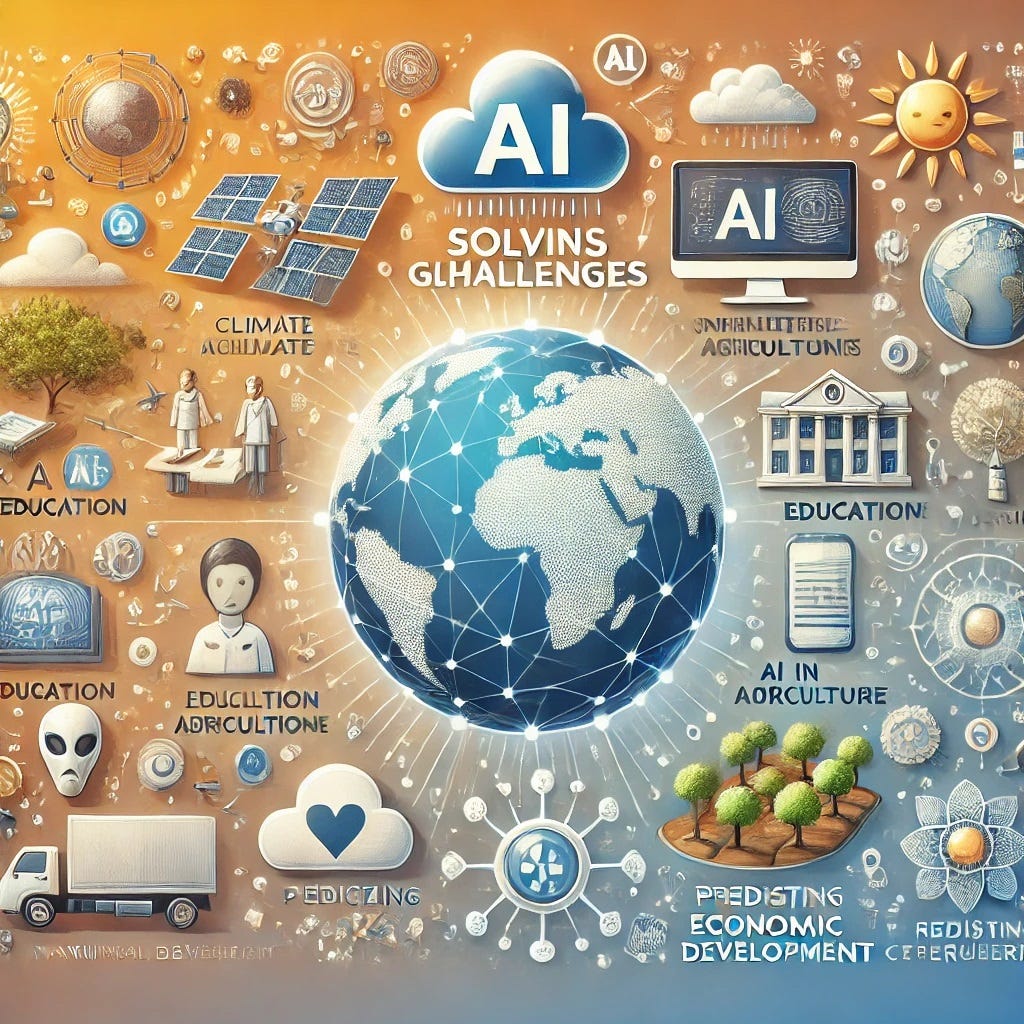
- Climate Change and Environmental Sustainability: AI models simulate climate scenarios, optimize energy consumption, and monitor deforestation using satellite imagery.
- Public Health: AI-powered diagnostic tools, outbreak prediction systems, and personalized medicine improve healthcare delivery and pandemic preparedness.
- Disaster Management: Machine learning algorithms analyze seismic, meteorological, and social data to forecast natural disasters and coordinate emergency responses.
- Economic Development and Poverty Alleviation: AI-driven financial inclusion tools, job market analysis, and resource distribution models support equitable growth.
- Education and Digital Inclusion: Adaptive learning platforms and AI tutors personalize education, while translation tools bridge language barriers.
#History / Background
The intersection of AI and global challenges traces back to the mid-20th century, with early developments in cybernetics and early computing laying the groundwork for intelligent systems. The term "artificial intelligence" was coined in 1956 at the Dartmouth Conference, marking the formal beginning of AI as a scientific discipline.
In the 1970s and 1980s, expert systems—AI programs designed to mimic human decision-making—were applied to complex domains such as medical diagnosis and geological exploration. However, limited computing power and data availability constrained their scalability.
The 1990s saw the rise of machine learning, particularly neural networks, which began to show promise in pattern recognition tasks. The advent of the internet and digital data collection in the 2000s accelerated AI development, enabling the training of large-scale models on diverse datasets.
A pivotal moment came in 2012 with the breakthrough of deep learning, demonstrated by AlexNet’s success in the ImageNet competition. This event catalyzed rapid advancements in computer vision, natural language processing, and reinforcement learning, making AI a viable tool for addressing global-scale problems.
In recent years, AI has been integrated into international initiatives, including the United Nations Sustainable Development Goals (SDGs), where it supports monitoring, evaluation, and implementation efforts across multiple targets.
#How It Works
AI systems designed to tackle global challenges typically operate through a combination of data collection, model training, prediction, and actionable output generation. The process can be broken down into several key stages:
#Data Collection and Integration
AI relies on high-quality, diverse datasets. Sources include satellite imagery, IoT sensors, public health records, economic indicators, and social media feeds. These datasets are often heterogeneous and require preprocessing—cleaning, normalization, and integration—to ensure consistency and usability.
#Model Training
Machine learning models, particularly deep neural networks, are trained on historical and real-time data to identify patterns and correlations. For example, a climate model may learn from decades of temperature, CO₂, and ocean current data to predict future warming trends.
Supervised learning uses labeled data to make predictions, while unsupervised learning identifies hidden structures in unlabeled data. Reinforcement learning enables systems to learn optimal strategies through trial and error, useful in resource allocation or policy design.
#Prediction and Optimization
Once trained, AI models generate forecasts—such as disease outbreak hotspots, crop yields, or energy demand—based on current inputs. Optimization algorithms then determine the most efficient allocation of resources, such as distributing vaccines or deploying emergency services.
#Decision Support and Action
AI outputs are often presented as dashboards, alerts, or automated recommendations to policymakers, healthcare providers, or field operators. In some cases, AI systems are embedded in autonomous systems—like drones for disaster assessment or robotic arms in manufacturing—that directly execute tasks.
#Feedback Loops
AI solutions are most effective when integrated with continuous feedback mechanisms. Real-world outcomes are fed back into the system to refine models, improving accuracy and adaptability over time.
#Important Facts
- AI can process data up to 100,000 times faster than the human brain in specific pattern-recognition tasks.
- The global AI market size in the context of sustainability and governance is projected to reach $36.8 billion by 2025, growing at a CAGR of 39.7%.
- AI-driven climate models have improved the accuracy of long-term temperature projections by over 20% in the past decade.
- In healthcare, AI systems have achieved diagnostic accuracy comparable to human experts in detecting breast cancer and diabetic retinopathy from medical images.
- AI-powered early warning systems have reduced disaster-related fatalities by up to 30% in pilot regions by enabling timely evacuations.
- Despite progress, 70% of AI projects in developing countries fail due to data scarcity, infrastructure gaps, or lack of local expertise.
- Ethical concerns include algorithmic bias, data privacy, and the potential displacement of jobs in vulnerable sectors.
#Related Terms
#FAQ
What does AI And Global Challenges: Tackling Big Problems cover?
Explores how artificial intelligence shapes global challenges and tackling big problems, covering practical use cases, benefits, limitations, and risks.
Why is AI And Global Challenges: Tackling Big Problems important?
It helps readers understand key concepts, compare practical use cases, and evaluate how Artificial Intelligence decisions affect outcomes, risks, and implementation choices.
What should readers verify before applying this topic?
Readers should compare the benefits, limitations, data requirements, and related themes such as Global, Challenge, Tackling before using the ideas in real projects.
#References
- AI And Global Challenges: Tackling Big Problems terminology and background research
- AI And Global Challenges: Tackling Big Problems use cases, implementation examples, and limitations
- Artificial Intelligence best practices, standards, and risk guidance
- Global case studies, benchmarks, and current industry analysis



Comments
No comments yet. Start the discussion with a useful note.