

#Short Answer
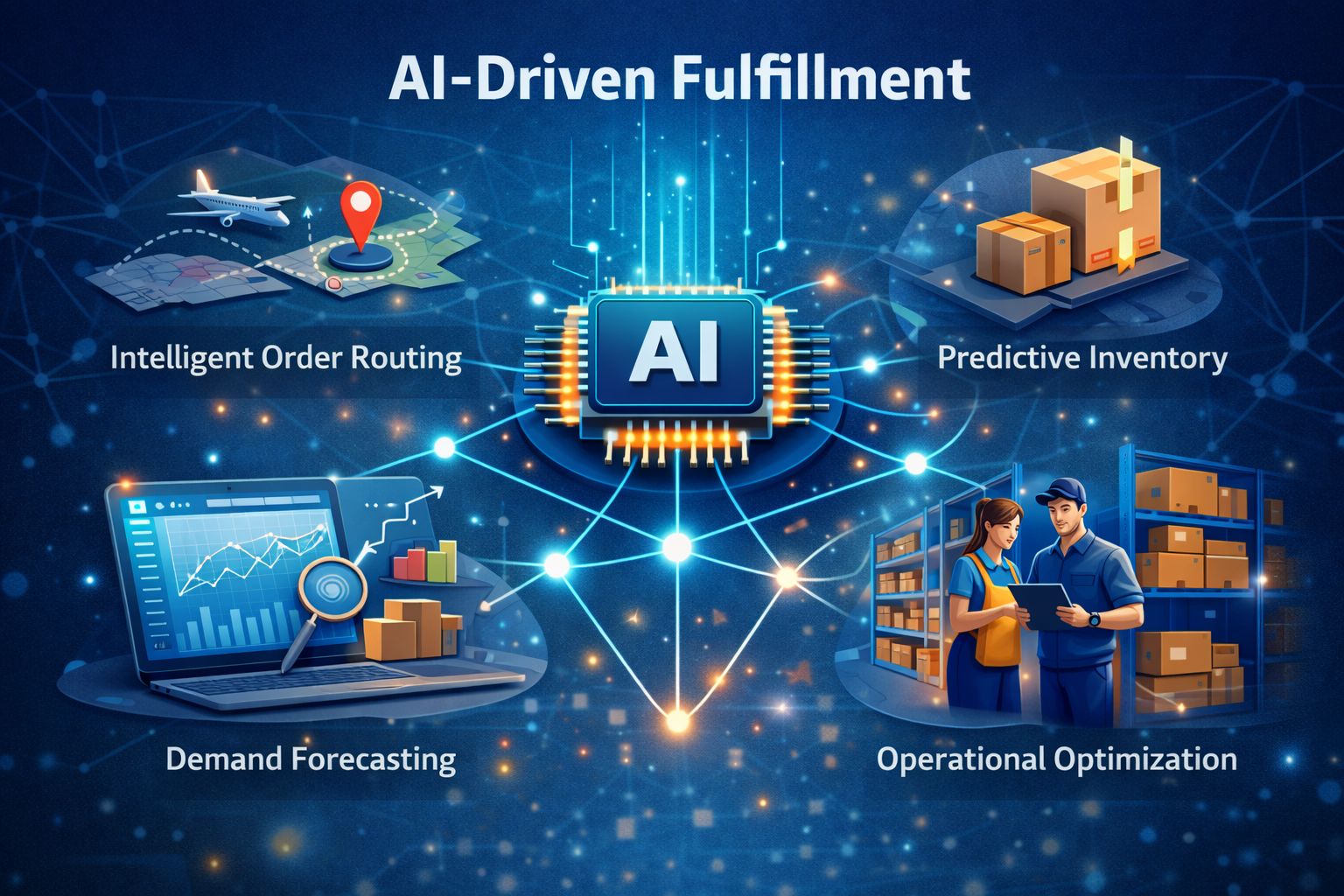
AI in fulfillment refers to the integration of artificial intelligence technologies—such as machine learning, natural language processing, and computer vision—into supply chain and order fulfillment processes to enhance efficiency, accuracy, and scalability. These systems automate decision-making, optimize logistics, and enable real-time tracking, reducing operational costs and improving customer satisfaction.
#Infobox
#Overview
Artificial Intelligence (AI) in fulfillment represents a transformative shift in how businesses manage supply chains, warehouse operations, and last-mile delivery. By leveraging AI-driven tools, organizations can automate complex decision-making processes, predict demand fluctuations, and optimize every stage of the fulfillment cycle—from order intake to product delivery. This integration not only enhances operational efficiency but also supports sustainability goals by minimizing waste and reducing carbon footprints through smarter routing and inventory strategies.
AI-powered fulfillment systems are particularly impactful in e-commerce, where high order volumes and customer expectations for rapid delivery demand agile solutions. Technologies such as machine learning enable systems to learn from historical data and continuously improve forecasting models, while computer vision facilitates real-time package sorting and quality control. The result is a fulfillment ecosystem that is faster, more reliable, and adaptable to market changes.
#History / Background
The concept of AI in fulfillment emerged alongside advancements in computing and automation during the late 20th century. Early applications focused on basic inventory management systems and barcode scanning, which laid the groundwork for more sophisticated AI integrations. The 1990s saw the rise of enterprise resource planning (ERP) systems, which began incorporating rule-based automation for order processing.
In the 2000s, the proliferation of e-commerce platforms such as Amazon and eBay accelerated the need for intelligent fulfillment solutions. Companies began experimenting with predictive analytics to forecast demand and optimize warehouse layouts. The introduction of robotics in warehouses, pioneered by Amazon’s acquisition of Kiva Systems in 2012, marked a turning point, enabling autonomous mobile robots (AMRs) to move inventory and assist in picking operations.
Since 2015, the integration of deep learning and cloud computing has further revolutionized fulfillment. AI models now process vast datasets in real time, enabling dynamic pricing, personalized delivery options, and even autonomous delivery vehicles. The COVID-19 pandemic (2020–2022) further accelerated adoption, as businesses sought contactless solutions and resilient supply chains to meet surging online demand.
#How It Works
#Demand Forecasting
AI-driven demand forecasting uses historical sales data, market trends, weather patterns, and even social media sentiment to predict future product demand. Machine learning algorithms analyze these variables to generate accurate forecasts, reducing overstock and stockouts. Techniques such as time series analysis and neural networks are commonly employed to detect patterns and anomalies.
#Inventory Management
AI enhances inventory management by dynamically adjusting stock levels based on real-time data. Computer vision systems scan barcodes and QR codes to track inventory movement, while AI-powered software recommends optimal reorder points and safety stock levels. This minimizes holding costs and ensures product availability. Advanced systems also integrate with supplier networks to automate replenishment orders.
#Warehouse Automation
Robotic systems, including automated guided vehicles (AGVs) and robotic arms, work alongside human workers to streamline warehouse operations. AI coordinates these robots, assigning tasks based on priority, proximity, and efficiency. For example, AI can determine the fastest route for a robot to pick and transport items, reducing travel time by up to 50%. Systems like Amazon’s “Just Walk Out” technology use AI and sensors to enable cashier-less checkout in physical stores.
#Order Picking and Packing
AI-powered picking systems use algorithms to optimize the sequence in which items are retrieved from shelves. Voice-directed picking and augmented reality (AR) glasses guide workers to the correct locations, reducing errors. In automated packing, AI selects the most suitable box size and packing materials based on product dimensions and fragility, minimizing material waste and shipping costs.
#Route Optimization
AI algorithms optimize delivery routes by analyzing traffic patterns, delivery windows, vehicle capacity, and fuel efficiency. Machine learning models continuously update routes in real time to account for delays or new orders. This reduces fuel consumption, lowers emissions, and improves on-time delivery rates. Companies like FedEx and UPS use AI-powered route optimization to save millions annually in operational costs.
#Last Mile Delivery
The final leg of delivery is often the most expensive and time-consuming. AI enables dynamic rerouting, real-time customer communication, and even autonomous delivery solutions. Drones and self-driving vans are being tested for short-distance deliveries in urban and rural areas. AI chatbots handle customer inquiries and reschedule deliveries, improving service quality and reducing call center workload.
#Important Facts
- Efficiency Gains: AI can reduce order fulfillment time by up to 60% and improve picking accuracy to over 99%.
- Cost Savings: Companies using AI in fulfillment report up to 30% reduction in operational costs.
- Sustainability Impact: AI-driven route optimization can cut fuel consumption by 15–20%, lowering CO₂ emissions.
- Customer Experience: AI-powered personalization increases repeat purchase rates by 20–30%.
- Market Growth: The global AI in logistics market is projected to reach $15.6 billion by 2027, growing at a CAGR of 21.6%.
- Adoption Rates: Over 60% of large retailers have implemented AI in at least one area of their fulfillment process.
- Data Dependency: AI systems require high-quality, real-time data; poor data quality can lead to inaccurate predictions and inefficiencies.
#Timeline
- A subset of AI that enables systems to learn from data and improve over time without explicit programming.
- The use of data, statistical algorithms, and ML techniques to identify the likelihood of future outcomes.
- Robots that navigate warehouse environments independently to transport goods.
- A virtual replica of a physical supply chain used for simulation, monitoring, and optimization.
- A decentralized ledger technology used to enhance transparency and traceability in supply chains.
- AI technology that enables systems to understand and generate human language, used in chatbots and voice assistants.
- AI that enables machines to interpret and make decisions based on visual input, such as image recognition and object detection.
- An inventory strategy that aligns raw
material orders from suppliers directly with production schedules.
- A fulfillment model that integrates online and offline sales channels to provide a seamless customer experience.
#Related Terms
#FAQ
What does AI And Fulfillment: Achieving Goals cover?
Explores how artificial intelligence shapes fulfillment and achieving goals, covering practical use cases, benefits, limitations, and risks.
Why is AI And Fulfillment: Achieving Goals important?
It helps readers understand key concepts, compare practical use cases, and evaluate how Artificial Intelligence decisions affect outcomes, risks, and implementation choices.
What should readers verify before applying this topic?
Readers should compare the benefits, limitations, data requirements, and related themes such as Fulfillment, Achieving, Goal before using the ideas in real projects.
#References
- AI And Fulfillment: Achieving Goals terminology and background research
- AI And Fulfillment: Achieving Goals use cases, implementation examples, and limitations
- Artificial Intelligence best practices, standards, and risk guidance
- Fulfillment case studies, benchmarks, and current industry analysis



Comments
No comments yet. Start the discussion with a useful note.