

#Short Answer
AI and cloud integration refers to the combination of artificial intelligence technologies with cloud computing platforms to create scalable, efficient, and intelligent business solutions. This integration enables organizations to leverage AI-driven insights, automate workflows, and process large datasets without the need for extensive on-premises infrastructure.
#Infobox
#Overview
AI and cloud integration is a transformative approach that merges the capabilities of artificial intelligence with the scalability and flexibility of cloud computing. By integrating AI models and algorithms with cloud-based infrastructure, businesses can enhance decision-making, optimize operations, and deliver personalized customer experiences. This synergy allows for the deployment of advanced AI applications such as natural language processing, computer vision, and predictive analytics without the constraints of traditional computing environments.
The primary advantage of AI and cloud integration is scalability. Cloud platforms provide on-demand computing resources, enabling AI models to handle large volumes of data efficiently. This eliminates the need for businesses to invest in expensive hardware or maintain complex IT infrastructure. Additionally, cloud-based AI services offer pre-built models and tools that can be customized to meet specific business needs, reducing development time and costs.
#Key Benefits
- Scalability: Cloud infrastructure allows AI applications to scale dynamically based on demand, ensuring optimal performance even during peak usage.
- Cost Efficiency: Organizations can reduce capital expenditures by leveraging cloud-based AI services on a pay-as-you-go model.
- Real-time Processing: Cloud platforms enable real-time data analysis and decision-making, which is critical for applications like fraud detection and personalized recommendations.
- Accessibility: AI models deployed in the cloud can be accessed from anywhere, facilitating remote work and global collaboration.
- Automation: AI-driven automation reduces manual intervention, improving efficiency and reducing human error.
#History / Background
The concept of integrating AI with cloud computing emerged in the early 2010s as cloud providers began offering AI services alongside their core infrastructure offerings. The rise of big data and the increasing complexity of AI models necessitated scalable computing resources, which cloud platforms could provide. Early adopters included tech giants like Google, Amazon, and Microsoft, who integrated AI capabilities into their cloud services.
In 2012, Google introduced the Google Cloud AI platform, followed by Amazon Web Services (AWS) launching Amazon SageMaker in 2017. Microsoft Azure also expanded its AI offerings with services like Azure Cognitive Services. These developments marked a significant shift toward democratizing AI by making it accessible to businesses of all sizes.
#Evolution of AI in the Cloud
The integration of AI and cloud computing has evolved through several phases:
- Early Integration (2010-2015): Initial efforts focused on providing basic AI services such as speech recognition and image classification through cloud APIs.
- Advanced AI Services (2015-2020): Cloud providers introduced managed AI services, including machine learning platforms and pre-trained models, enabling businesses to build custom AI solutions without deep expertise in AI.
- AI-Driven Automation (2020-Present): The focus shifted toward automating end-to-end business processes using AI, with cloud platforms offering tools for natural language processing, computer vision, and predictive analytics.
#How It Works
AI and cloud integration involves several key components that work together to deliver intelligent, scalable solutions:
#Cloud Infrastructure
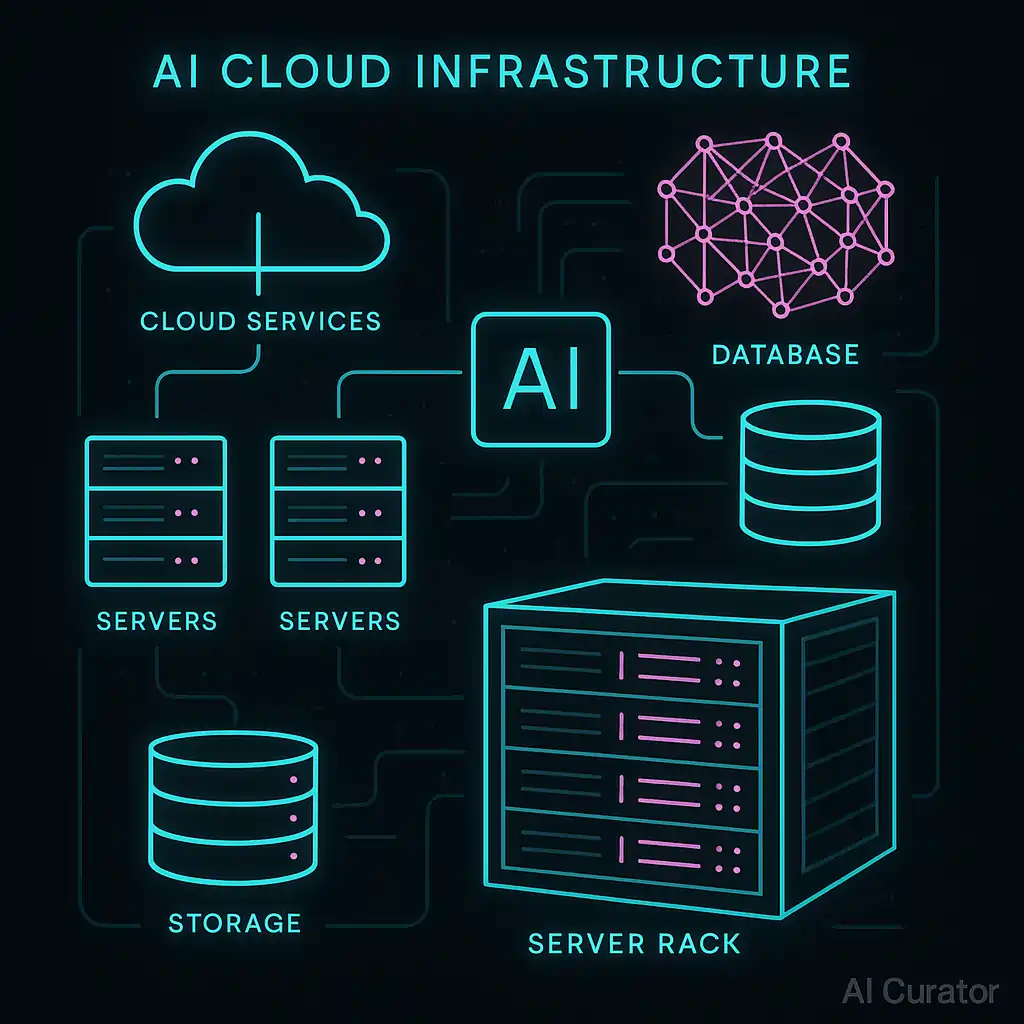
The foundation of AI and cloud integration is the cloud infrastructure, which provides the necessary computing power, storage, and networking resources. Cloud providers offer various service models, including:
- Infrastructure as a Service (IaaS): Provides virtualized computing resources such as virtual machines, storage, and networks.
- Platform as a Service (PaaS): Offers a platform for developing, testing, and deploying applications without managing the underlying infrastructure.
- Software as a Service (SaaS): Delivers AI applications as ready-to-use software, accessible via the internet.
#AI Models and Algorithms
AI models, such as machine learning and deep learning algorithms, are deployed on cloud infrastructure to process data and generate insights. Common AI techniques used in cloud integration include:
- Supervised Learning: Uses labeled data to train models for tasks like classification and regression.
- Unsupervised Learning: Identifies patterns in unlabeled data, useful for clustering and anomaly detection.
- Reinforcement Learning: Enables AI systems to learn from interactions with an environment, often used in robotics and gaming.
- Natural Language Processing (NLP): Processes and analyzes human language, enabling applications like chatbots and sentiment analysis.
- Computer Vision: Analyzes visual data, such as images and videos, for applications like facial recognition and object detection.
#Data Pipelines
Data pipelines are essential for feeding data into AI models. Cloud-based data pipelines automate the collection, transformation, and storage of data, ensuring that AI models have access to high-quality, up-to-date information. Tools like Apache Kafka and AWS Glue are commonly used to streamline data ingestion and processing.
#Deployment and Monitoring
Once AI models are trained, they are deployed on cloud platforms using services like AWS Lambda or Azure Kubernetes Service. Continuous monitoring ensures that models perform optimally, with tools like Amazon CloudWatch and Azure Monitor providing real-time insights into model performance and system health.
#Important Facts
- Market Growth: The global AI in cloud market is projected to reach USD 135.9 billion by 2026, growing at a compound annual growth rate (CAGR) of 24.5%.
- Adoption Rates: Over 90% of organizations are either using or planning to use AI in conjunction with cloud services.
- Energy Efficiency: Cloud-based AI can reduce energy consumption by up to 90% compared to on-premises solutions, thanks to shared resources and optimized data centers.
- Security: Cloud providers implement advanced security measures, such as encryption and multi-factor authentication, to protect AI models and data.
- Regulatory Compliance: AI and cloud integration helps businesses comply with data protection regulations like the GDPR and CCPA by providing secure data storage and processing environments.
#Related Terms
#FAQ
What does AI And Cloud: Scalable Solutions cover?
Explores how artificial intelligence shapes cloud and scalable solutions, covering practical use cases, benefits, limitations, and risks.
Why is AI And Cloud: Scalable Solutions important?
It helps readers understand key concepts, compare practical use cases, and evaluate how Technology decisions affect outcomes, risks, and implementation choices.
What should readers verify before applying this topic?
Readers should compare the benefits, limitations, data requirements, and related themes such as Cloud, Scalable, Solution before using the ideas in real projects.
#References
- AI And Cloud: Scalable Solutions terminology and background research
- AI And Cloud: Scalable Solutions use cases, implementation examples, and limitations
- Technology best practices, standards, and risk guidance
- Cloud case studies, benchmarks, and current industry analysis


Comments
No comments yet. Start the discussion with a useful note.